Bikesure_adrianflux

Rear sprocket carrier - clunker Q

900Rebuilder

Registered
Joined
Sep 20, 2022
Messages
587
Location
Beeston
Bike
M900
Hi All,

Quick question!

I've just got my wheels back from powder coating and installed some new bearings and cush drive rubbers.

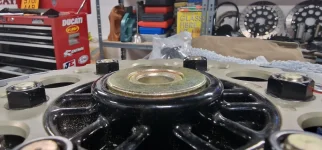
The rubbers are low enough not to hold the sprocket carrier up but I can see approx a 2mm air gap between it and the wheel which I'm sure isnt correct. I've got the domed spacer in the cush drive with the domed part facing into the hub - is this right?

Cheers - Ben
 
Maybe it closes up with wear?

After 25k miles, mine does have a little bit of play in the cush drives as in the carrier does very slightly rattle back and forth.

That said, I've just had a close look and, my mistake there is actually a small gap, maybe not quite as much as yours but something and if I 'wiggle' the sprocket it will open/close the gaps very slightly so could be by design?

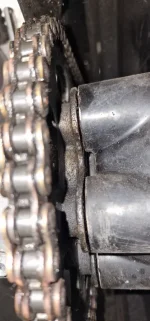
13358-1778510881-47ead901eefd2c5f38199cf943214085.jpg
 
There's got to be a working clearance between the sprocket carrier and hub because there is movement between the two if the cush rubbers are doing their job, or more so if the pins are worn.
I'm not sure what actually governs that clearance now, as I haven't seen the back of my sprocket carrier for 3 or 4 years now. It's going to come against the nearside wheel bearing at some point, so if that's not properly home in it's housing it could push the carrier outwards?
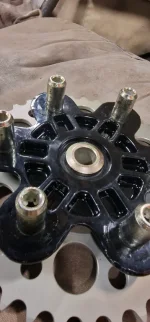
I don't recall any shoulders on the drive pins? which would abut to the centre steel part of the cush bush if they existed, but again that's a working joint and so contact would probably be undesirable?

Something that is very tight with this setup is the sprocket nut to swinging arm clearance, particularly the swinging arm end plate, so if you think the carrier is a bit further out than it should be it's well worth checking that clearance, which is minimal at best anyway.
On the ally swinging arms the plates are handed and the shaved one goes on the sprocket side to give the nuts some room.
 
This is the other side
 

Attachments

  • 20260511_185406.webp
    20260511_185406.webp
    45.2 KB · Views: 4
  • 20260511_185248.webp
    20260511_185248.webp
    79.2 KB · Views: 4
  • 20260511_185415.webp
    20260511_185415.webp
    45.9 KB · Views: 4
There's got to be a working clearance between the sprocket carrier and hub because there is movement between the two if the cush rubbers are doing their job, or more so if the pins are worn.
Indeed, thinking about it, the gap allows for some flex in the cush drives which is what's supposed to happen so must be correct.

The fact mine is tighter is most likely because it's half knackered and will probably start eating into the wheel next. :LOL:
 
Indeed, thinking about it, the gap allows for some flex in the cush drives which is what's supposed to happen so must be correct.

The fact mine is tighter is most likely because it's half knackered and will probably start eating into the wheel next. :LOL:
Good to know 👍
 
Indeed, thinking about it, the gap allows for some flex in the cush drives which is what's supposed to happen so must be correct.

The fact mine is tighter is most likely because it's half knackered and will probably start eating into the wheel next. :LOL:
That happened to my S4tr, when I first bought it I noticed metal filings around the front sprocket cover, further investigation found the cush rubbers knackered and because of the amount of movement it was eating into the eccentric adjuster of the swingarm! New cush rubbers sorted it out
 
That happened to my S4tr, when I first bought it I noticed metal filings around the front sprocket cover, further investigation found the cush rubbers knackered and because of the amount of movement it was eating into the eccentric adjuster of the swingarm! New cush rubbers sorted it out
The same thing happened to my 916.
One cush drive ‘popped’, came apart and machined the eccentric hub down to just a couple of mm.
Needed a new hub as there wasn’t really enough meat left on it to get the C spanner on to adjust it.
A Renthal sprocket carrier with a ‘lip’ to stop the cush drives popping out prevents it happening again.
 
I ended up doing the same thing with the renthal sprocket carrier (lovely bit of kit), fortunately for me there was just enough meat on the eccentric adjuster, I made my own c-spanner out of a sheet of stainless steel ;-)
 
I've always wondered if someone made a CNC carrier for the old clunkers as the stock one weighs quite a lot - changed to a Renthal sprocket which weighs nothing but bit of a pointless exercise really!
 
I tried a Renthal sprocket on mine, munched through it in a couple of thousand miles.

I now use a SuperSprox composite (alloy centre, steel tooth ring) which does last better and is lighter than a full steel but, I'm already on my second one and, the first being worn out in short order and the current one is showing a fair amount of wear.

Contrast that with my 916 with +30hp and a heavier bike to boot and is running with an alloy Renthal and lasting well. It is a 525 chain compared to a 520 on the Monster but even so my Monster has a huge appetite for tyres, chains, sprockets, clutches and gearboxes... :eek:
 
Am I right in thinking you don't run a shock absorber in your clutch hub?
If so that might be the reason for high transmission consumption?
 
Am I right in thinking you don't run a shock absorber in your clutch hub?
If so that might be the reason for high transmission consumption?
Correct, I wasn't doing as I had a billet clutch hub with no cush rubbers (much lighter than the 2-piece OEM) though I did just refit the OEM type with cush for that very reason when I changed the clutch a couple of months back so we'll see what difference that makes going forward.

That said, I've had the same billet clutch hub in the 916 for years and it has given me no bother so when I built the Monster, I copied the 'winning' formula but it definitely hasn't been as successful on the Monster. :(

It must be down to the power delivery which is, shall we say, less 'sophisticated' on the Monster despite it making less power and torque than the 916 which is also much more progressive.

The Monster makes it's power much lower down the rev range with a bigger initial punch (stronger under 6k rpm) and whilst that is one of the appeals of it, it is definitely more maintenance intensive.
 
Back
Top